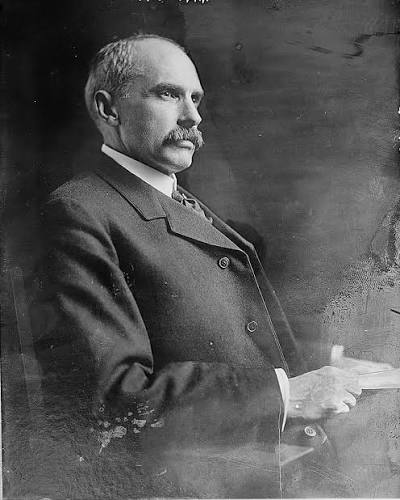
 John Cotton Dana (August 19, 1856 – July 21, 1929) was a prominent American librarian, museum director, and educational reformer.
Queer Places:
Dartmouth College (Ivy League), 10 N Main St, Hanover, NH 03755
Newark Museum, 49 Washington St, Newark, NJ 07102, United States
River Street Cemetery, 15 River St, Woodstock, VT 05091, United States
John Cotton Dana (August 19, 1856 – July 21, 1929) was a prominent American librarian, museum director, and educational reformer.
Born in Woodstock, Vermont, he studied at Dartmouth College and later was admitted to the New York bar, though he chose a career in library science and public education instead.
Dana served as the first librarian of the Denver Public Library (1889–1897), where he pioneered open-shelf access for patrons. He subsequently headed the City Library of Springfield, Massachusetts, before settling into his most influential post as the librarian of the Free Public Library of Newark, New Jersey (1902–1929). In Newark, he also founded the Newark Museum in 1909, advocating for the integration of museums and libraries into everyday community and industrial life. He believed museums should display accessible, everyday items and practical design rather than merely elite antiquities.
The Horace Walpole Society is an exclusive, historically all-male organization dedicated to the study and appreciation of American decorative arts, architecture, and history. Established initially in Boston in October 1909, its official foundational meeting took place on January 21, 1910, in Hartford, Connecticut, with an initial roster of 21 accepted members.
John Cotton Dana was among the elite group of early cultural leaders, bibliophiles, and museum directors invited to join the society at its inception.
He was elected a member in 1910 and resigned shortly after in 1911.
While John Cotton Dana himself was a married man with a family, intersections with queer history appear in a few specific contexts surrounding his legacy, networks, and broader archival projects:
Biographical outlines of early-20th-century cultural figures like Dana—and historical tracking of exclusive societies such as the Horace Walpole Society—are frequently documented within specialized biographical dictionaries and online compendiums dedicated to documenting queer spaces, homosocial institutional networks, and cultural history (such as projects mapping historical figures and elite homosocial formations).
References:
Support this project
This website is a passion project researched, developed, and funded entirely by me. If you find the content valuable and would like to help support the ongoing research and hosting costs, any contribution is deeply appreciated.
Thank you for keeping this independent resource alive!
My books on Amazon: Elisa Rolle's books